Church Buildings Aren’t What They Used To Be
Church buildings are a problem.
Not that we should do away with them, I’m all for a physical presence in a community for God’s people to gather. But lately, the conversations I have with pastors often center around the building feeling like a boat anchor, and not a resource, for their ministry. It shows up again and again as a real source of stress and anxiety for many churches and they are looking for ways to deal with this issue.
The strain churches feel around their property rarely comes from a single source; it builds in layers over time:
Volunteer Burnout: Aging facilities demand constant upkeep, and a shrinking pool of volunteers simply cannot keep pace with the relentless maintenance burden.
Skyrocketing Costs: Operational expenses that fit neatly into the budget a decade ago now stretch church finances beyond their breaking point.
Inflexible Footprints: Built during peak attendance years, these structures were designed to hold massive crowds, not to adapt fluidly to a smaller worshipping body.
Relational Isolation: Too often, the church facility functions as a sanctuary from the neighborhood rather than a bridge to it. Despite offering occasional polling space or wedding rentals, it remaining deeply disconnected from daily community life.
Tangled Identity: Over time, the congregation’s identity becomes wrapped up in the brick and mortar itself. Emotional attachment to a physical structure quietly paralyzes the church's ability to dream about what could be.
When I get calls from churches about this sort of problem, usually the request is to “help us grow back into the building.” That’s the solution: help us just reach people, so that they give money, so that we can stay in the building. There are a lot of problems with that line of thinking, no the least of which is the idea that reaching our community is simply a means to the end of keeping ourselves feeling comfortable. But even beyond that, "growing back into our space" assumes that returning to the past is the ultimate goal and I believe that preserving yesterday’s footprint is simply not the win anymore.
I think for churches who are looking at their old building, or even building NEW buildings, the win is all about asking “how does this resource draw us TOWARD relationships in the community. That could include changing our proximity to our neighbors, that could be about partnering with organizations, or even redesigning our space to be more community-first, church-second approach.
Ultimately, the goal is to look at your building as an asset. Not an asset for our worship ministry, Sunday school and potlucks for the congregation, but as an asset for the community.
In my previous church we thought a lot about building something that would be useful for the community if the church ever moved on. Here are three resources that you might find helpful in pursuing a new vision for the property of the church.
Rooted good will tell you plainly that this common issue with facilities is THE opportunity for the church right now. They’ll tell you that your source of pain is actually a huge asset that can be repurposed for something that will meet the needs of the community and generate income.
They have a ton of resources that are designed to help congregations and leaders think differently about their property and explore what opportunities God might be inviting them into. The “Good Futures Accelerator” is a specific tool that I love because it turns this kind of exploration and discernment into a game that anyone in the church can lead you through.
This is really a key step in uncovering a new vision that moves a church from “how do we get back to the past” to “what’s next for our future?”
While Rooted Good provides the tools, we’ve found that having a partner like Ministry Architects to facilitate and coach churches through the process has been a huge bonus and helps churches actually put into action what they are learning.
My friend Dusty is piloting a brand-new opportunity for churches who have done the work to envision a new partnership with the community in their property. He’s built a tool that can radically simplify the connection between facility and community. If you’re ready to start using your space with the community, Gather can give you an easy online portal to manage rentals and more in a way that lets you focus on relationships and not back-end property management.
ICCF Community Homes
For decades, ICCF Community Homes has been working in the West Michigan area to develop equitable opportunity, affordable homes, and thriving neighborhoods. I recently sat down with Ryan, the executive director to learn about how they do this. There are multiple ways they accomplish this vision, but the heart behind it is that in order for communities to change, there has to be room for people to afford to live there.
Most people hear “affordable housing” and think “low” or “no income housing.” Often (especially in suburban or gentrifying urban areas this creates fear that the neighborhood would become “undesirable.” Sometimes this is true, but it doesn’t have to be. Today, “affordable housing” also means “middle income” housing.
Housing prices, rents, mortgage rates are the highest they’ve been in years. Which is great for those of who bought when the prices and rates were low long ago. But what does this mean for a family who makes $80,000 a year? Can they afford what passes as “entry level” homes in a suburban area? Often the answer is “no.”
Places like ICCF work in land trust opportunities to keep housing rates 80-120% of the average home value in an area. This doesn’t change the value of homes, or remake the community, but it does give opportunity to people that most churches claim they’d like to support.
In our conversation, Ryan said something that surprised me. I envisioned his work in partnering with churches to be about purchasing or acquiring old church property and demolishing it for housing, but he has a different approach. “The church can keep their building,” he said, “and we can build a neighborhood around it.”
You see, many churches who are asking property questions might have large parking lots, unused acreage, or even a parsonage that’s not used by the pastor anymore.
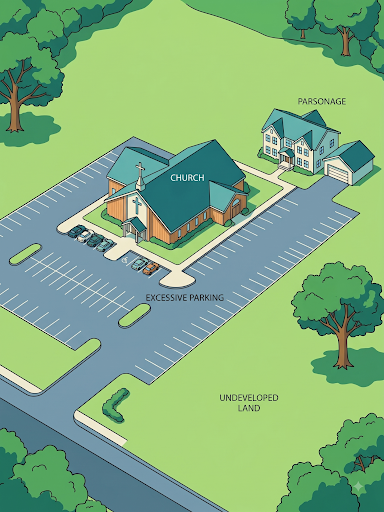
Ryan’s vision for this kind of property would be to purchase parts of the property to develop single-family, middle-income housing that promotes the church building as shared community space. The purchase affords the church finances to remodel and retrofit the church facility, the church continues to meet and worship, and new neighbors can afford housing steps from the church’s front door.
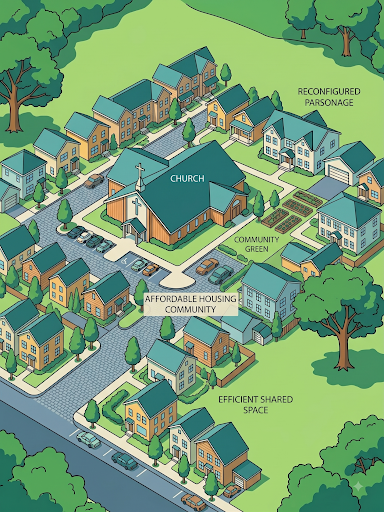
This vision is about sharing the resources so that it meets the needs of the church and the community. In fact, ICCF Community Homes has done this with their property. Their offices are on the ground floor with affordable apartments above and all of this is directly attached to a church. Some apartment residents will come down for worship in their pajamas and the church uses the apartment common spaces for their mid-week gatherings.
What strikes me most is how many churches are already trying to service people in their communities with assistance ministries (like school supplies, food programs or pantries, or others), but have never thought about integrating their property to reach the same group of people. In fact, it could even bring them to your doorstep, giving you the opportunity to build relationships with them.
I love these opportunities not because of how successful they may be, but because how the help churches re-imagine a new future and develop a new vision. When it comes to our church property, we can’t go back to the day it was built and we can’t solve our problems with a quick fix. But a change in vision could open up an entire new kind of ministry and relational engagement with your community. You can’t go back to when your church was built back in the 90’s (or the 1890’s for some!), but you can reimagine the kind of ministry and impact your facility can have for today.
Can we help you rethink your property? Reach out at scottpontier.org
