When One Size Doesn’t Fit All, How Do You Measure Ministry? (Hint: It Might Be Easier Than You Think)
The opening weekend illusion
These days, there is a lot of handwringing over box office numbers. Supergirl opened last week, and the weekend box office dollars were much lower than expected. People speculate about what this means for the film industry, the studio, and their future plans. One producer wisely said, “Yes, it’s lower than we want, but I think our future plans for the DC Comics characters are still something we believe in.” I love that the producer is basically naming, that there are other measurements of success other than the opening weekend box office dollars.
This is smart because it’s hard to compare those numbers in a season of rapid inflation. 3D and IMAX offerings charge different rates, and what if you factor in streaming when someone buys or rents it at home? Perhaps the better version of measuring engagement is how many people watched the film (showed up at the theater, rented it, bought it, or streamed it). Saying four million people watched a movie this weekend might feel different than whatever dollar amount that translated to. That doesn't mean we don’t track dollars (it’s a business, after all), but the more meaningful metric might be different.
Similarly, churches are going through a transition regarding how they measure success. Historically, leaders relied almost exclusively on two metrics: weekly giving and Sunday morning attendance. People assumed these two numbers revealed the health of a community.
Churches are in a transition of what meaningful metrics are. It used to be worship attendance and giving, pretty exclusively. Those two numbers told us how healthy or impactful a church is. I’m noticing that’s not true anymore. There are plenty of large churches that are low on impact beyond Sunday, while smaller churches with small budgets have kingdom impact happening. When you add the changing patterns of engagement on top of that, things get even messier.
The Hidden Congregation
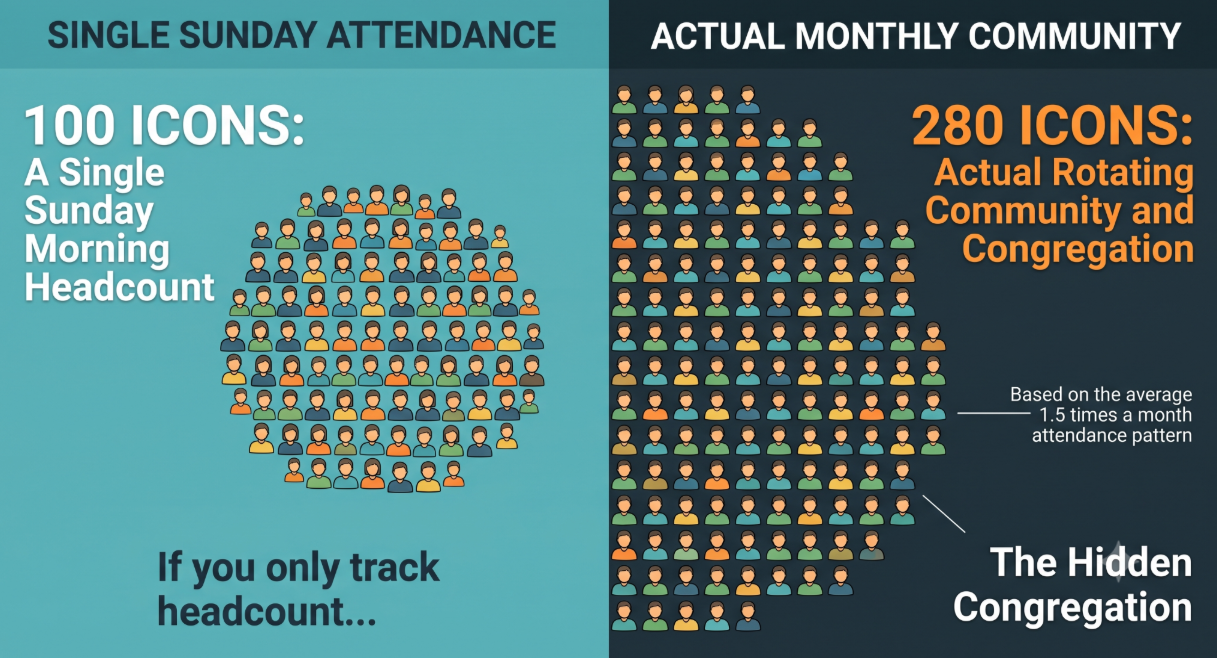
Today, the average churchgoer attends services about 1.5 times a month. If your building hosts an average of 100 people on a typical Sunday morning, your actual congregation may be much larger. Based on the attendance statistic, your active community is actually between 267 and 289 people.
If you only track headcount, you look at your data and say, "We are a church of 100." But in reality, you have a rotating community of nearly 280 regular people who consider you their church family. If you only measure the 100 seats filled on a single morning, you are completely missing the other 180 people you are actively ministering to throughout the month. This is exactly why measuring names known and impact matters so much more than just counting filled chairs.
And that’s just Sunday attendance. What about the impact a church makes outside the worship service?
There used to be a day where a church’s faith community started with Sunday morning and then added a Bible study or small group midweek, a service opportunity throughout the month, youth group attendance, or a spot on the softball team. Today, you’re just as likely to engage someone through one of your other ministry areas as you are on Sunday morning. There are plenty of people today who call your church their home but engage only in a non-Sunday way.
Realistically, weekly worship attendance and financial giving are good metrics to have, but they misrepresent the actual ministry of the church when used as sole measurements.
Practicing Empathy in Ann Arbor
I observed this challenge firsthand in Ann Arbor while working with a church that received a grant to design new programs for children. As we thought about the target audience for their work, the complaint came up about sports. It’s one I hear at almost every church I go to: kids these days are too busy with sports to come to church on Sundays. The complaint usually leads to a feeling of, “If these families would just change what they do and show up on Sundays, then we could actually disciple them.”
I have to believe we’re better at being the Church than remaining stuck because our 10:00 a.m. weekly slot isn’t fitting into the lives of families. There are other approaches we can take.
In fact, we decided to practice a little empathy. What if you were a family with multiple kids in travel sports, which, by the way, seem to be the only option to get your kid involved in something active? Now you’re locked into really full schedules, driving different kids to different teams. It’s chaotic and unpredictable; you never know what the plan will be three weeks from now.
Maybe those parents would love a regular engagement with their kids at church to build discipleship relationships. If you were designing a brand new ministry for that audience, I bet just one hour, one time a week on the weekend might not be a smart strategy. In fact, you might decide instead to say, “We're holding worship services every day of the week at different times to meet the needs of today's sporadically scheduled families.” My guess is that, with more options, you’d actually reach more people.
But that’s a big blow to the camp that believes everyone has to be in the same room at the same time, isn’t it? It changes the way you think about how you can measure what success looks like. I think that’s a good thing.
Measuring church like a pair of pants
There are a ton of metrics we can use to measure our ministry (I’ll even include a link to a dashboard at the end), but let’s start with the simplest approach to measuring ministry health. Think of it like a pair of men's pants, which require two numbers: length and waist. We can measure churches using two distinct metrics instead of a single headcount.
The ministry measurement: This tracks the total number of people who maintain a relationship with your community over a month (not weekly), even if they only engage through non-Sunday ministries or come once a month to a worship service.
The missional measurement: This tracks your direct outward impact on the neighborhood. For example, if your members pack food bags for a school backpack program, this metric records the number of students you feed.
You can still keep a list of data points like weekly attendance, baptisms, and giving. However, simplifying your primary metrics to these two numbers clarifies the true size, scope, and impact of your faith community.
I think one real benefit of this approach is that it forces a church to focus on a central discipleship strategy: relationships. It forces you to think about the names of the people you impact rather than only the heads you count. It invites you to consider your church through the lens of, “Who are the people we know and whose spiritual lives we are shaping?”
I led in youth ministry in the early 2000s, when the end goal was usually just to make a big enough spectacle to get as many teenagers to walk through the door as possible, counting that as the win. While some may still care about that, more and more churches and Christians are actually valuing a different result, rooted in making disciples.
The Next Frontier
The North American church currently operates on systems that fail to match modern realities. Buildings drain resources, leadership models strain under financial pressure, and traditional strategies often cling to the past.
I don’t think the church is failing. I think it’s waiting to be reimagined.
I often use an expedition metaphor for where I see the church headed. We’re still navigating some familiar terrain, using territory and language that sounds familiar, like systems, leadership, mission, and change. But within each terrain, there are new frontiers, edges where the path forward is unclear. These are the places where the church must blaze new trails, build bridges, and take risks.
How we measure our ministry is an important frontier for the church because the metrics we use to define success will ultimately shape what we do. Right now, many churches are getting hammered by their current metrics. Attendance and giving are down, and there’s no simple lever to pull to reverse that trend. So let’s not.
The tools of the past cannot measure the possibilities of tomorrow. By choosing to track relationship and neighborhood impact over mere attendance, we stop apologizing for empty chairs and start celebrating real kingdom movement. It is time to step off the old map, embrace the metrics that matter, and see how a community transforms when it is finally ready to be reimagined.
I’d love to help you navigate change in your church and you can find lots of help and resources at scottpontier.org but you can click here if you want to download the New Ministry Dashboard and explore what changing metrics might be for your church.
